GEO Report Switzerland 2026: two in three SME websites do not tell AI who they are
10,676 Swiss SME websites checked for AI: 88 % have no FAQ, 84 % no llms.txt, 63 % no clear company data. What is missing and what saldiaBuild includes.
 Stefan Sempach 10 min read
Almost two in three SME websites in Switzerland do not tell AI assistants who is behind them. 88 % do not answer a single customer question directly on the home page, and 84 % have no llms.txt. These are the findings of the GEO Report Switzerland 2026 (in German), which checked 10,676 websites from 15 industries and all 26 cantons.
The report comes from wältibidu solutions, the company of our CEO and co-founder Men Wälti. Here we sum up what the figures mean for your business, which three steps have the biggest effect and which of them a website built with saldiaBuild already includes.
The key figures at a glance
| Finding | Share of websites checked |
|---|---|
| Answers no customer questions directly on the home page (no FAQ, no questions as subheadings) | 88 % |
| No llms.txt for AI assistants | 84 % |
| No machine-readable entry with company name, location and offering | 63 % |
| No structured data (Schema.org) | 48 % |
| Blocks the search crawlers of AI assistants | 1 % |
On average, an SME website reaches 64 out of 100 points on the GEO score. Only 33 % score 80 or more, and 14 % are below 50. Source of all figures in this post: GEO-Report Schweiz 2026, waeltibidu.ch.
What GEO is and why it matters for your business
GEO stands for generative engine optimisation: a website is built so that AI assistants can read it, understand it and name it in their answers. The report describes the reason like this: anyone who googles today reads Gemini's AI answer first, and more and more customers ask ChatGPT, Claude and other assistants directly.
For a painting business in Thun or a physiotherapy practice in Aarau, this means the question "Who does this near me?" is answered by an AI more and more often. To do that, the AI has to be able to match a business's name, location and offering without doubt.
The AI gets in, but understands too little
Access is rarely the problem. Only 1 % of the websites block a search crawler of the AI assistants, and 3 % block a training crawler. On 8 %, the content only appears through JavaScript and stays empty for AI crawlers.
So the AI gets in almost everywhere. It just finds too little there that it can clearly understand and quote. These are the three biggest gaps:
- No direct answers (88 %). The home page has neither an FAQ nor a question as a subheading. According to the report, these question-and-answer pairs are exactly what AI assistants like to pick up.
- No llms.txt (84 %). In a few lines, this file tells AI assistants who you are and where the most important pages are.
- No clear sender (63 %). There is no entry with company name, location and offering that machines can read without doubt. Just under half of all websites (48 %) have no Schema.org structured data at all.
Industries and regions: small differences, shared gaps
Estate agencies (68 points) and law firms (67) score best. Joineries (61) and architecture firms (56) come last. The other eleven industries, from electricians and dental practices to fiduciary firms, are between 62 and 66 points. Among architecture firms, 29 % of the websites score below 50 points, more than in any other industry. The report notes that the differences between industries are smaller than the gaps they all share.
The regions are close together too: French-speaking Switzerland reaches 66 points, German-speaking Switzerland 63 and Ticino 62. Only 7 points separate the best canton (Geneva with 68 points) from the bottom of the field (61). The rankings of all 15 industries and 26 cantons are in the report.
The basics are often missing too
Besides AI visibility, the website check behind the report also looks at the basics of a website. This is the picture there:
- 69 % lack important security headers.
- 61 % show no preview when someone shares the link (Open Graph).
- 50 % do not protect their email domain against spoofing (SPF or DMARC is missing).
- 49 % have incomplete SEO basics (title, description, H1).
- 46 % have no reference to a legal notice or privacy policy on the home page.
The three steps with the biggest effect
The report recommends three things every business can do:
- Tell the machines who you are. An entry with company name, location, offering and opening hours as LocalBusiness schema. According to the report, one hour of work with a big effect.
- Answer your customers' questions. An FAQ with the questions you hear every day.
- Provide a short version for the AI. An llms.txt with the most important details and pages.
The free website check (in German) shows you where your website stands. It is the same check that was used for the 10,676 websites in the report: 23 checkpoints, and the result arrives in about ten seconds.
Retrofit or rebuild?
According to the report, almost all of this can be retrofitted to existing websites without a rebuild. If your website works well, that is the right way: you add the missing points yourself or have someone do it for you.
Things are different if a new website is due anyway, if the current one is showing its age or if you do not have one yet. Then it costs less to start with a tool that includes the technical foundation from the beginning than to fix it point by point later.
What saldiaBuild includes out of the box
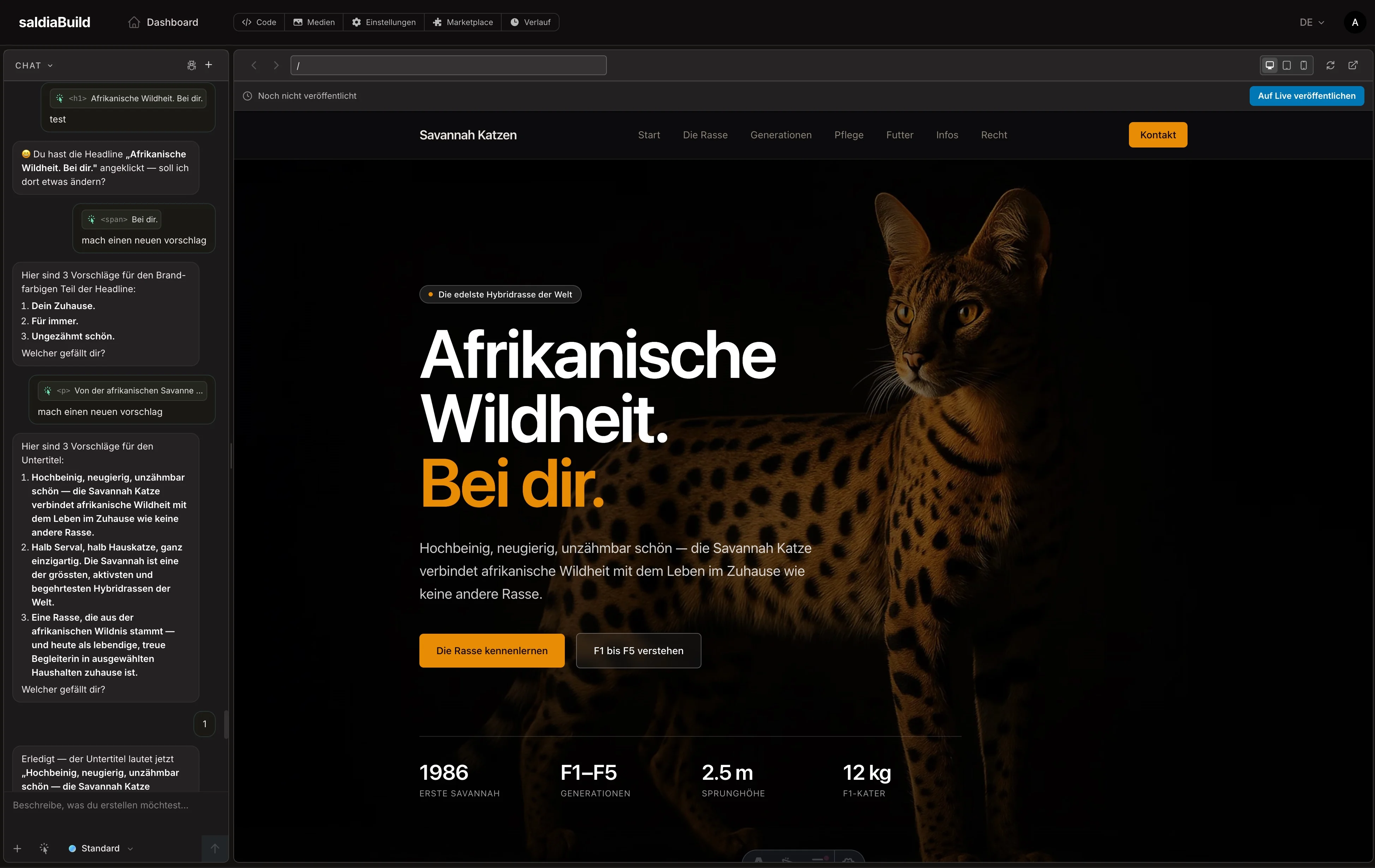
saldiaBuild is our AI website builder: you describe your project, the AI builds a complete website from it, and the finished website is hosted in Switzerland. You do not need to know or order the technical points from the report. They are created with every publish:
| Gap according to the report | Missing on | In saldiaBuild |
|---|---|---|
| Company data for machines (name, location, offering) | 63 % | Your company details are on every page as structured data. If you enter your address, phone number and opening hours for a new website, your business appears as a LocalBusiness entry. |
| Structured data (Schema.org) | 48 % | Present on every page. |
| llms.txt | 84 % | Generated again with every publish, with name, description and list of pages. |
| Content readable without JavaScript | 8 % | The pages are delivered as finished HTML. |
| Preview when sharing (Open Graph) | 61 % | Title, description and image are set on every page. |
| SEO basics (title, description, H1) | 49 % | The AI gives every page a title, a description and exactly one H1. |
| Image descriptions (alt texts) | 14 % | The AI gives every image an alt text. |
| Security headers | 69 % | Set by our hosting for every website. |
| Legal notice and privacy policy | 46 % | Both pages exist from the start and are linked in the footer. |
A sitemap is also generated automatically and listed in robots.txt.
Nothing is made up along the way: saldiaBuild only publishes addresses, phone numbers and opening hours that you entered yourself. What has been added since the summer is listed in the saldiaBuild news.
The one point you contribute yourself is the FAQ. Only you know which questions your customers ask every day. Building it then takes one sentence in the chat, for example: "Add an FAQ with these eight questions to the home page." The AI builds the section, writes the answers from your notes and marks up the FAQ as structured data. You check them and publish with one click.
The side finding on email (50 % without SPF or DMARC) concerns the domain and not the website. If your domain is with us, you enter the required DNS records right in the domain overview in saldiaBuild.
Why this is the less expensive solution
On an existing website, each of these points is a task of its own: a plugin, a change to the theme, a job for the agency. After a redesign you have to check that everything is still there. In saldiaBuild these points are part of the platform. You do not pay for them one by one, and they stay in place when you change texts, add pages or switch the domain.
saldiaBuild is available from CHF 9 per month (billed annually), Swiss hosting and SSL certificate included. On the Free plan you create your website with the credits we give you, and you see the result before you decide. All plans are on the pricing page.
Do you already have a website? With the website import, saldiaBuild takes over the content and structure of your current site and rebuilds it. The points from the table are then included. And if you would like to do nothing yourself, you can have our team build your website.
What the figures do not say
The report names its own limits. It is based on OpenStreetMap: all businesses from 15 industries that are listed there with a website were checked, without chains and branch operations. Of 13,043 websites on record, 10,676 could be reached and were evaluated. So that the many restaurants do not dominate the picture, every industry counts equally in the overall figures. This is not the same as all Swiss SMEs: restaurants and urban businesses tend to be more strongly represented in OpenStreetMap.
The GEO score also measures the technical requirements for AI assistants to read and understand a website. It does not measure whether an AI recommends your business in a specific case. The same goes for saldiaBuild: the platform provides the foundation. What the website says, meaning your offering, your answers and your references, is still up to you.
Conclusion
Most SME websites can be reached by AI assistants but are hard for them to understand. Three things change that: clear company data, an FAQ and an llms.txt. First use the website check to see where you stand. If only a few points are missing, retrofit them. If a new website is due, start with saldiaBuild: the technical part is then done from the first publish.
Frequently asked questions
What is GEO?
GEO (generative engine optimisation) means building a website so that AI assistants such as ChatGPT, Claude or Gemini can read it, understand it and name it in their answers. This includes machine-readable company data, direct answers to customer questions and an llms.txt.
What is an llms.txt?
An llms.txt is a small text file in the root directory of a website. In a few lines it tells AI assistants who is behind the website and where the most important pages are. According to the GEO Report Switzerland 2026, it is missing on 84 % of the SME websites checked.
How do I check whether AI assistants understand my website?
With the free website check from wältibidu solutions at waeltibidu.ch/website-check (in German). It checks 23 points on AI visibility, basics and SEO and shows the result in about ten seconds.
Do I have to rebuild my website to be visible to AI?
No. According to the GEO report, almost everything can be retrofitted to existing websites. A rebuild pays off if a new website is due anyway. In that case the tool should include the technical foundation from the start.
What does saldiaBuild include for AI visibility?
Every website published with saldiaBuild contains structured data about your business, an llms.txt, a sitemap, a robots.txt, Open Graph details and security headers. The pages are delivered as finished HTML and hosted in Switzerland. You add an FAQ with one sentence in the chat.